
How to Improve Difficult Relationships at Work Using the Trust Equation
Do you have a tricky relationship with someone at work? It might be your boss, a co-worker, direct report, or someone else you need to work closely with on a regular basis. Sometimes we can pinpoint what feels off. Maybe they’re micromanaging you, or being disrespectful to you, or playing politics. Other times it can be difficult to work out exactly what’s going on. We just know it feels tough to work with them. We dread seeing their name pop up in our inbox or calendar.
And whilst you might tell yourself that you just need to ignore it, move past it, and stop letting them get to you, it’s never that easy in practice. It’s not a very effective strategy either. Pushing your emotions down and ignoring your feelings rarely works in the long term. Our pesky emotions still have a way of bubbling up and impacting us, just when we least expect it. Unresolved conflict between colleagues will also have a significant impact on the performance of a team, or an organisation. So, in my view you owe it both to yourself, and to your organisation, to tackle the issue.
In this article, I’d like to introduce you to something that’s been working really well for my clients with tricky relationships: the trust equation.
Created by Maister, Green and Galford, and introduced in their book The Trusted Advisor in 2000, the trust equation explains how leaders and colleagues build trusted relationships in professional environments. In the trust equation, trust is built through a combination of three factors:
💛Credibility: do you know what you’re talking about?
This relates to your expertise, track record of success and how well you demonstrate expertise and competence.
💛Reliability: do you do what you say you’ll do?
This one is all about consistency and dependability. Do you deliver on time? Do you meet your commitments?
💛Intimacy: do people feel safe to be vulnerable with you?
How open are you? How interested are you in others? Can you create genuine connections, based on empathy and understanding?
Trust is eroded by a single factor:
💛Self-orientation: are you focused only on yourself, for your own gain?
If you come across as selfish this destroys trust. Minimising self focus and crushing your ego dramatically improves relationships.
Here’s what the trust equation looks like expressed mathematically:
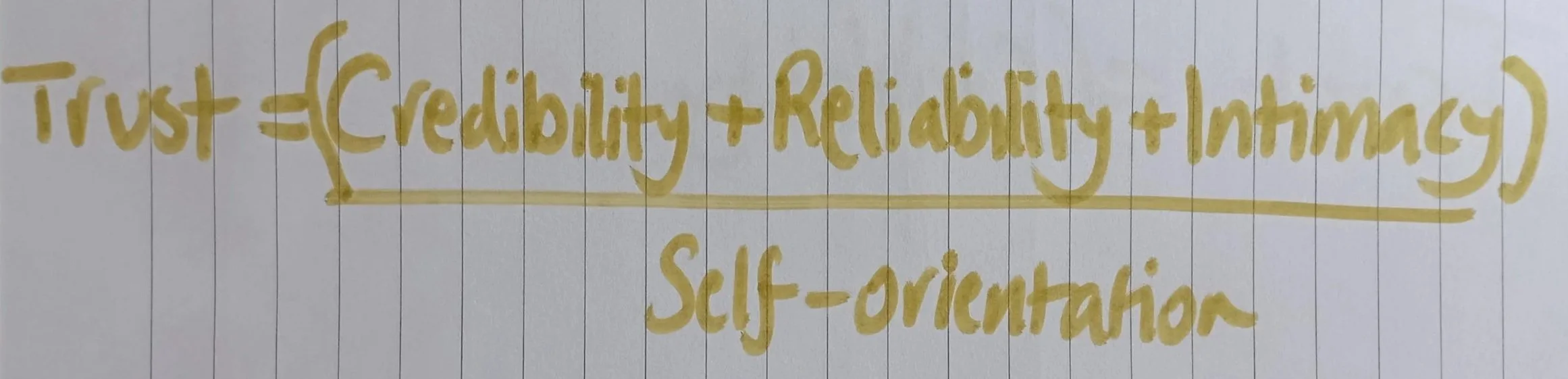
You can use the trust equation to improve your relationships with colleagues by considering it as a compass, to help guide you through analysing what specifically can be increased or decreased. Here’s some steps to work through:
💛Identify a tricky relationship you’d like to improve
💛Consider each element of the trust equation from the perspective of how you show up in this relationship. Assess which areas are higher and lower in the context of this particular relationship.
💛Now, consider each element of the trust equation in terms of how the other person shows up.
💛Reflect on what you’ve noticed. Are there areas that you are both showing up well in? Are there areas you are both finding hard? Are there differences?
💛Now, pick something you could start doing in this relationship, something you could stop doing, and something you could continue doing well.
When I’ve worked on this with clients, we’ve uncovered all sorts of areas that can be worked on to improve tricky relationships.
For example, one director I worked with found it very difficult to interact with his boss. Using the trust equation we identified that intimacy was very low in this relationship. There was very little personal, human connection between them. They knew hardly anything about each other. My client could improve this by creating opportunities for informal conversations, for asking questions and taking a genuine interest in his boss’ life.
With another leader, I was helping him to improve his leadership skills, having recently taken on a larger team and scope of responsibility. We looked at how he was showing up in relationships with each of his direct reports using the trust equation. My client identified that he wasn’t as consistent as he’d like. He felt his moods were variable and could see how his team might be unsure what version of him they were getting from one day to the next. We explored how dialling up intimacy might help with this - by sharing more openly how he was feeling, it could reduce the unpredictability his colleagues felt from one day to the next.
💛Are there any relationships in your life that you’d like to run more smoothly? I’d like to challenge you to consider them through the lens of the trust equation. Let me know how you get on.
💛💛And, if you’d like help to improve your working relationships, and transform your career through one-to-one coaching with me, then just use this link to set up an initial chat with me https://calendly.com/liv-yellowbenchcoaching/30min_discovery_call
